

SARAH Project
Introduction
Alternatives to hospitalisation in mental health
The healthcare and social services system in Quebec is facing major challenges, especially when it comes to mental health. The high occupancy rate in emergency rooms is a worrying trend that puts a lot of pressure on the system. On top of that, psychiatric hospitalization is sometimes seen by patients as a negative and stigmatizing experience that can even slow down the recovery process.
In response to these issues, three key actions are being highlighted:
- Brief Community Support (ABC - Accompagnement bref dans la communauté)
- Short-Term Psychiatric Intervention Unit (UIBP - Unité d'intervention brève en psychiatrie)
- Brief Intensive Home Treatment (TIBD - Traitement intensif bref à domicile)
These actions aim "to prevent hospitalization or to shorten it, as well as to support the person's continued living at home or a quick return to it" (Ministère de la Santé et des Services sociaux, 2022 cited in Santé Québec, 2025). Although these actions have their specificities, their strength lies in their coming together and complementing each other, which is reflected in the establishment of a Specialized Integrated Mental Health Services Hub (Plateau).
SARAH project
The Rapid Learning System for Alternatives to Hospitalization (SARAH) builds on the work of the Specialized Integrated Mental Health Service Hub (Plateau). SARAH coordinates the collection and analysis of data from the three initiatives and stakeholders. This data feeds into feedback and collective reflection processes that help adjust practices and continuously improve care and services in real-time. It supports teams in a collective learning approach, based on combining and integrating clinical, experiential, and scientific knowledge.
Showcase establishments
The establishments below have each of the three actions: ABC, UIBP, and TIBD.
- Santé Québec Laval
- Santé Québec Outaouais
- Santé Québec Capitale-Nationale
- Santé Québec Est-de-l'île-de-Montréal
- Santé Québec Ouest-de-l'île-de-Montréal
- Santé Québec Mauricie-et-Centre-du-Québec
- Santé Québec Centre-Ouest-de-l'île-de-Montréal
- Santé Québec Centre-Sud-de-l'île-de-Montréal
Stakeholders
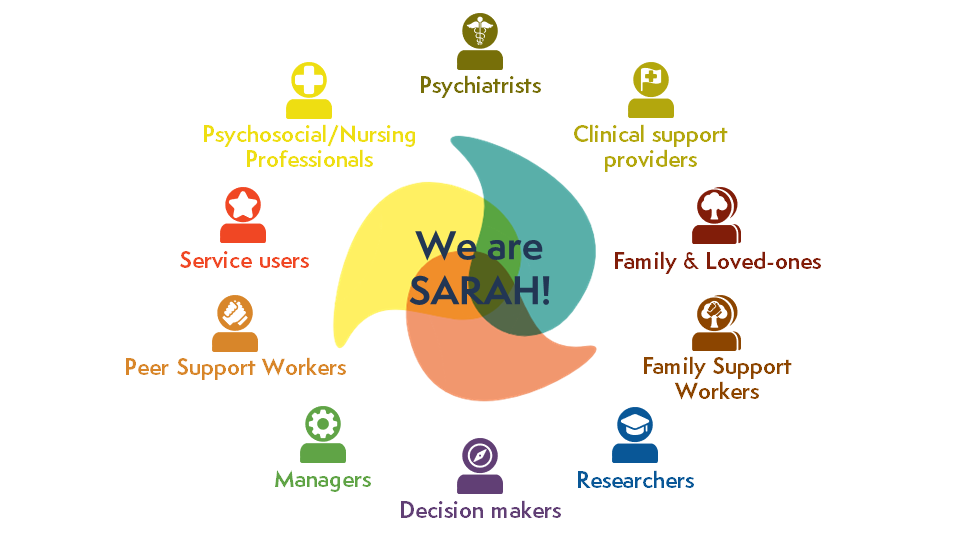
Improving practices and services relies on the joint contribution of people from various backgrounds: users, loved ones, clinicians, psychiatrists, managers, researchers, policymakers, and support teams. The circular representation highlights the importance given to combining different kinds of knowledge and recognizing the complementarity of experiential, clinical, organizational, and scientific know-how.
From this perspective, the different stakeholders are seen as full partners, whose contributions are recognized and used in a spirit of collaboration, dialogue, and collective learning. This approach aims to encourage fair participation from everyone involved.
The diagram below shows the variety of stakeholders involved in the process and highlights the richness of the perspectives brought in.
Relevant documentation and resources
Conceptual framework and application guides
Learning community members
All tools and meetings are accessible to SARAH members on a private page.